How Artificial Intelligence Is Changing Software Engineering and Why Remembering Syntax No Longer Matters
For decades, software engineering has been defined by one core skill: writing code. Knowing syntax, memorizing APIs, and mastering frameworks were the markers of competence. Engineers were valued for how fluently they could translate ideas into precise instructions that computers would accept.
That definition is quietly collapsing.
Reference: Ryan Dahl's perspective on the evolution of software engineering.
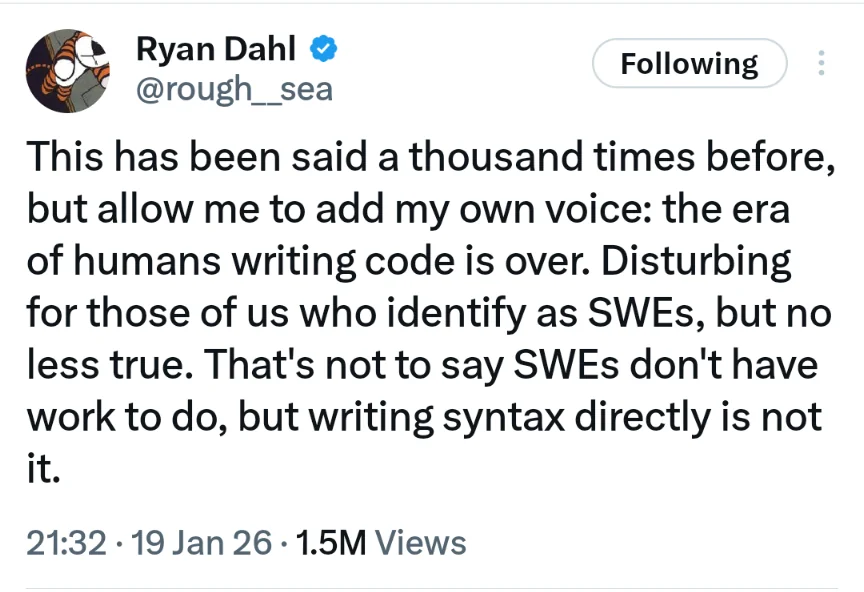
When Ryan Dahl, the creator of Node.js, stated that the era of humans writing code is over, it resonated because it captured something many engineers are already experiencing. Not panic. Not replacement. A shift. The work is changing, and so is what it means to be good at it.
AI has not killed software engineering. It has changed where the value lives.
The Decline of Syntax as a Core Skill
Let’s be honest about something the industry rarely says out loud: most engineers spend an enormous amount of time fighting syntax, configuration, and tooling rather than solving actual problems.
- Looking up function signatures
- Remembering framework-specific conventions
- Debugging trivial syntax errors
- Relearning patterns forgotten since the last project
This was never the point of engineering. It was a side effect of working with machines that demanded perfect instructions.
AI removes that bottleneck.
Today, engineers can describe what they want to build in plain language and receive working code in seconds. The need to remember exact syntax is rapidly fading, replaced by the ability to review, guide, and refine.
Syntax still exists. It just no longer deserves center stage.
Software Engineering Is Becoming More About Thinking Than Typing
A common misconception is that AI makes engineering easier or less skilled. In reality, it exposes weak thinking faster.
AI is very good at generating code that looks right. It is much worse at understanding:
- Business constraints
- Long-term maintainability
- Performance trade-offs
- Security implications
- Edge cases that only exist in production
Those responsibilities still belong to humans.
As a result, modern software engineering is shifting upward. The most valuable engineers are no longer the ones who type the fastest, but the ones who think the clearest.
This is why AI doesn’t replace engineers. It removes busywork and raises expectations.
From Writing Code to Directing Systems
The role of the engineer is evolving from “code author” to something closer to a systems director.
Instead of manually writing every line, engineers now:
- Define intent and constraints
- Guide AI-generated implementations
- Review and validate outputs
- Catch subtle logical and architectural flaws
- Decide what should and should not exist
This shift doesn’t reduce accountability. It increases it. When code becomes cheap, bad decisions become expensive.
The real skill is knowing when generated code is wrong, incomplete, or dangerously confident.
Why Clear Thinking Is the New Competitive Advantage
If remembering syntax is no longer essential, what replaces it?
Precision of thought.
Engineers who succeed in an AI-driven landscape are those who can:
- Break vague problems into clear requirements
- Communicate intent unambiguously
- Understand system boundaries and failure modes
- Ask better questions before writing anything
AI responds directly to the quality of the input. Ambiguous thinking produces fragile systems. Clear thinking produces leverage.
This is not about learning clever prompts. It is about learning how to think like an engineer again, stripped of unnecessary friction.
What This Means for Learning Software Engineering
For new engineers, this is good news.
Less time will be spent memorizing syntax and more time will be spent learning:
- Core computer science fundamentals
- System design and architecture
- Debugging and reasoning skills
- Real-world constraints and trade-offs
For experienced engineers, the challenge is psychological. Many built their identity around technical recall. Letting go of that feels uncomfortable.
But engineering has always evolved. This is just the next abstraction layer.
The Future of Engineering Is Intent-Driven
Ryan Dahl’s statement isn’t a declaration of defeat. It’s a reframing of the profession.
Humans are no longer the best tool for writing syntax. Machines are. Humans are still the best tool for understanding problems, defining constraints, and making judgment calls under uncertainty.
Software engineering isn’t ending. It’s becoming more human.
And ironically, that’s because machines finally learned how to write code.
- Sabih